What Changes About Anti-Inflammatory Eating When the Weather Turns Cold
Quick Answer: The anti-inflammatory principles do not change with the season - polyphenols, omega-3s, fiber, and low added sugar still do the work. What changes is the delivery format. Salads and smoothies become unappealing when it is cold, and appetite shifts toward warm and dense. Move the same compounds into soups, braises, and roasted vegetables. Cooking actually increases the availability of some compounds, so the seasonal switch costs you far less than people assume.
Every anti-inflammatory plan looks like a salad, and every salad looks less appealing the colder it gets.
The compounds do not care what temperature they arrive at.

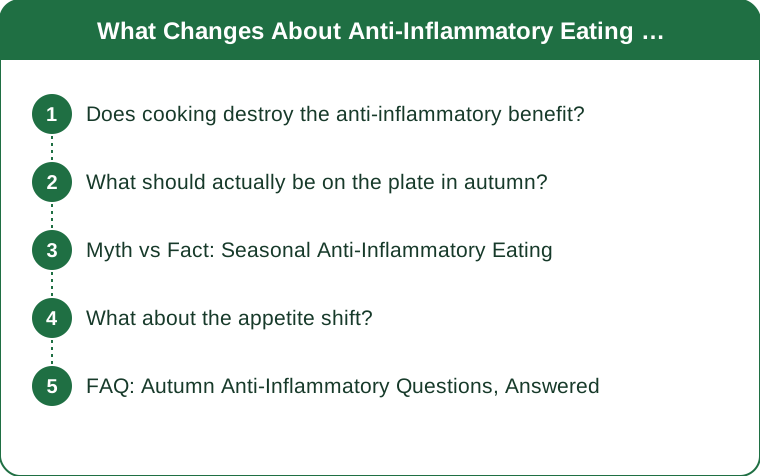
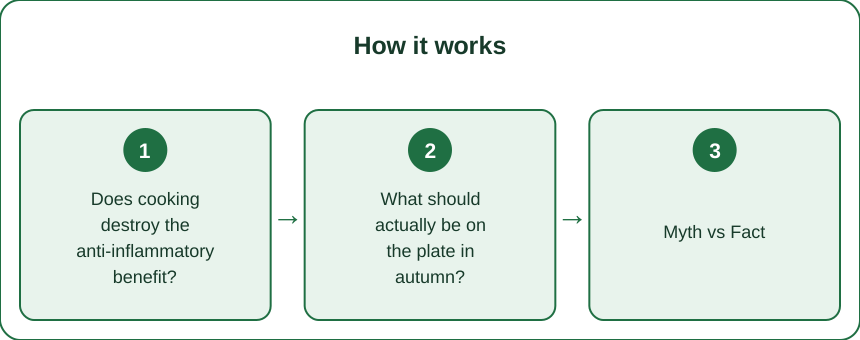
Does cooking destroy the anti-inflammatory benefit?
Sometimes, sometimes the reverse - and the reverse is more common than people expect.
Cooking reduces some heat-sensitive nutrients, notably vitamin C and certain B vitamins. That part of the folklore is accurate.
But cooking substantially increases the bioavailability of several key compounds. Lycopene in tomatoes becomes considerably more absorbable when heated, which is why cooked tomato products test higher than raw. Beta-carotene absorption from carrots improves markedly with cooking, especially with a little fat. The carotenoids in squash and sweet potato behave the same way.
Cooking also breaks down cell walls, which makes many polyphenols more accessible. And for a lot of people, cooked vegetables are simply easier to digest in volume - which matters, because the quantity you actually eat outweighs small differences in nutrient retention.
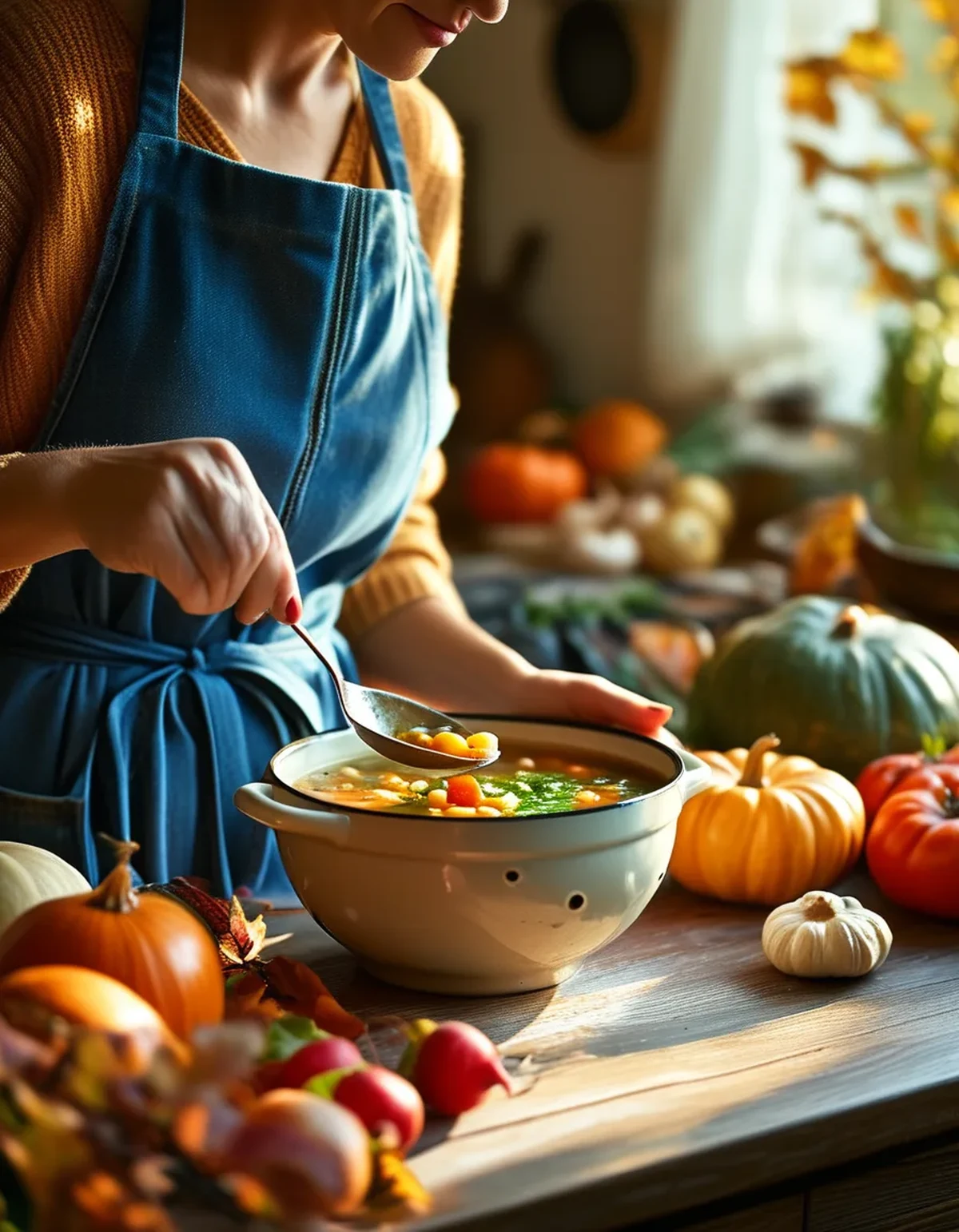
The practical read: a large bowl of vegetable soup in November beats a salad you did not want and did not finish.
What should actually be on the plate in autumn?
The same categories, in warm formats.
- Deeply colored root vegetables. Sweet potato, carrot, beet, winter squash. All rich in carotenoids and all better absorbed cooked with a little olive oil.
- Brassicas. Brussels sprouts, cauliflower, cabbage, kale. Roasting rather than steaming makes them palatable enough to eat regularly, which is the metric that matters.
- Fatty fish, twice a week. Salmon, sardines, mackerel. This is the highest-value single item on any anti-inflammatory list and it works in warm formats easily.
- Legumes. Lentils and beans move into soup season naturally, and they carry both fiber and plant protein.
- Alliums and spices. Onion, garlic, ginger, turmeric. Autumn cooking uses these more heavily than summer cooking does, which is a genuine seasonal advantage.
- Extra virgin olive oil, still, and used generously. It carries oleocanthal, which is one of the better-studied anti-inflammatory compounds in the Mediterranean pattern.
Notice what happened - that is a list of things that already belong in a soup or a roasting tray.
Myth vs Fact: Seasonal Anti-Inflammatory Eating
Myth: Raw is always better than cooked. Fact: It depends entirely on the compound. Vitamin C prefers raw; lycopene, beta-carotene, and several polyphenols prefer cooked. A mixed approach across the week beats dogma in either direction.
Myth: You need a smoothie every morning. Fact: You need the fiber and polyphenols. A bowl of oats with berries and walnuts delivers a comparable profile while being warm, which meaningfully improves the odds you eat it in January.
Myth: Winter produce is nutritionally inferior. Fact: Winter storage crops - squash, cabbage, root vegetables - are dense in exactly the compounds this pattern targets. Frozen produce, picked and frozen at peak, is also nutritionally comparable to fresh and often better than out-of-season fresh that traveled a long way.
Myth: Soup means losing the nutrients into the water. Fact: Only if you discard the liquid. In a soup you eat the broth, so water-soluble nutrients come with it. Boiling and draining is what loses them - which is an argument for soup over boiled sides.
What about the appetite shift?
Appetite genuinely changes when it gets cold, and pretending otherwise is why plans fail in the shoulder season.
Most people want warm, dense, and larger portions. Trying to override that with cold plates does not work as a long-term strategy, and it produces a specific failure pattern: a virtuous salad at lunch followed by whatever is available at 4pm.
Better to work with the shift than against it:
Front-load the volume in warm formats. A big bowl of vegetable soup as a first course reliably reduces total intake at a meal, and it fits the craving rather than fighting it.
Roast a tray twice a week. Squash, sprouts, onions, whatever is around. It becomes the default side for three dinners, which removes the daily decision.
Keep one cold item that you actually like. Not a full salad - something like sauerkraut or a citrus segment alongside a warm plate. It preserves variety without demanding a cold meal.
Batch the legumes. A pot of lentils on Sunday covers soups, bowls, and sides for four days.
FAQ: Autumn Anti-Inflammatory Questions, Answered
Is frozen produce as good as fresh in winter?
Generally yes, and frequently better than out-of-season fresh. Produce for freezing is typically harvested at peak ripeness and frozen within hours, while fresh out-of-season produce is picked early and travels. For berries specifically, frozen is the pragmatic year-round choice.
Do I need to take a supplement in the darker months?
Vitamin D is the one with a genuine seasonal argument, since synthesis from sunlight drops substantially at higher latitudes from about October to March. Whether you need one, and at what dose, depends on your levels - which is a blood test conversation with your doctor, not a guess.
Does hot food itself cause inflammation?
No. Temperature is not the variable. Cooking method matters somewhat - very high-heat charring produces compounds worth limiting - but roasting, braising, and simmering at ordinary temperatures are all fine.
Should I stop eating salads entirely?
No, just stop requiring them. If you want a salad, have one. The failure mode is treating cold raw vegetables as the only valid format, which makes the whole pattern feel like a chore for five months of the year. This is general information, not medical advice.
TL;DR:
- The principles do not change seasonally - only the delivery format does.
- Cooking increases availability of lycopene, beta-carotene, and several polyphenols, while reducing vitamin C. A mixed week covers both.
- Move the same foods into soups, braises, and roasting trays. What you actually eat beats what you theoretically should.
- Fatty fish twice a week remains the single highest-value item.
- Frozen produce is a legitimate winter choice, often better than out-of-season fresh.
- Work with the appetite shift toward warm and dense rather than fighting it.
The reason anti-inflammatory eating collapses in autumn is almost never a loss of conviction. It is a template built for July being applied in November. Change the format, keep the ingredients, and the pattern survives the season. This is general information, not medical advice.
Keep Reading
This article is for general informational purposes only and is not medical advice. Always consult a qualified health professional for guidance specific to you.