Your Anti-Inflammatory Diet Falls Apart Every September — Here's Why
Quick Answer: Anti-inflammatory eating doesn’t collapse in September because the food got harder. It collapses because the schedule that supported it disappeared — later dinners, earlier mornings, and a commute that eats the window you used to cook in. Fix the structure first: pick the one meal that broke, rebuild that meal only, and let the rest follow. Changing what you eat before you’ve fixed when you eat is why it keeps failing.
August you was doing great. Salads that took ten minutes. Fish twice a week. Berries because they were sitting right there.
By the third week of September it’s takeout on Tuesday, cereal for dinner on Thursday, and a vague sense of personal failure. Nothing about your intentions changed. Your calendar did.

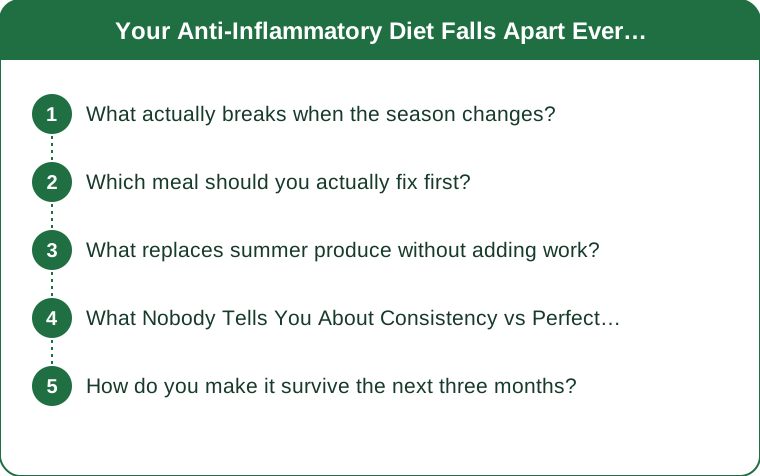
What actually breaks when the season changes?
Three specific things, and it’s worth naming them because they’re structural, not moral.
The cooking window moves. Summer dinners happen in daylight when you’re not tired. In September the same 6:30pm is dark, cooler, and lands after a longer day. The meal that took ten minutes in July feels like a project.
The produce you defaulted to disappears. Peak summer eating is easy because the food requires no technique — tomatoes, berries, cucumbers, stone fruit. All of it is either gone or expensive and mediocre by late September. If your pattern depended on food that needs no cooking, autumn removes the pattern.
The schedule gets rigid. School runs, earlier meetings, activities on weeknights. Summer’s flexibility is what let you shop twice a week and cook when you felt like it. That flexibility is gone and it isn’t coming back until June.
Notice that none of these are about willpower or knowledge. You didn’t forget that vegetables are good.
Which meal should you actually fix first?
One meal. Not the diet.
Figure out which one broke by looking at the last week honestly. For most people it’s dinner — it’s the meal furthest from the morning’s intentions and closest to the day’s fatigue. For people with new early commutes it’s breakfast, which quietly became coffee.
Then rebuild only that meal, with a rule rather than a recipe. Rules survive tired evenings; recipes don’t.
A workable dinner rule: one protein, one cooked vegetable, one thing with color, done in one pan. That’s salmon with roasted broccoli and a lemon. It’s chicken thighs with cabbage and paprika. It’s white beans, kale, and olive oil. All of these are anti-inflammatory in composition without anyone having to think about the word.
A workable breakfast rule: protein plus fiber, assembled not cooked. Greek yogurt, walnuts, frozen berries. Thirty seconds.
The key is that once one meal is stable for two weeks, the others get easier on their own, because you’re no longer starting each day already behind.

What replaces summer produce without adding work?
The autumn version of no-technique produce is different, and it’s mostly about heat and the freezer.
Roasting is the autumn equivalent of slicing a tomato. One tray, 425°F, 25 minutes, no attention required. Cauliflower, broccoli, carrots, squash, brussels sprouts — all genuinely good this way and all in season and cheap right now. The work is four minutes of chopping; the oven does the rest while you do something else.
Frozen berries are not a compromise. They’re picked at ripeness and flash-frozen, and their polyphenol content holds up well. In September, frozen blueberries are better than the sad fresh ones flown in from elsewhere, and they cost a third as much.
Canned and jarred are allowed. Sardines, canned salmon, white beans, canned tomatoes. These are the backbone of Mediterranean-pattern eating and none of them require planning.
Herbs and spices do heavy lifting. Turmeric, ginger, garlic, rosemary — all with reasonable evidence behind them, all shelf-stable, all the difference between roasted vegetables you eat and roasted vegetables you throw out on Friday.
What Nobody Tells You About Consistency vs Perfection
The uncomfortable finding underneath most nutrition research: the pattern matters far more than any individual food.
Studies on Mediterranean-style eating measure adherence over months and years, not the presence of any single ingredient. Nobody’s inflammatory markers moved because of one specific salmon dinner. They moved because of what the average week looked like across a long stretch.
This has a practical implication people resist: a mediocre meal you actually eat beats an ideal meal you skip. Rotisserie chicken and a bag of pre-washed spinach is a fine anti-inflammatory dinner. It’s not aspirational. It’s Tuesday.
The corollary is where most September collapses actually happen. One bad week gets interpreted as failure, the whole framework gets abandoned, and then it’s November. The pattern was never broken — one week of a fifty-two week average is statistical noise.
What nobody tells you: the people who eat this way long-term are not more disciplined. They’ve just built a smaller number of repeated meals — usually five or six dinners on rotation — so the decision load is near zero. Variety is a luxury of a season when you have time. In September, repetition is the strategy.
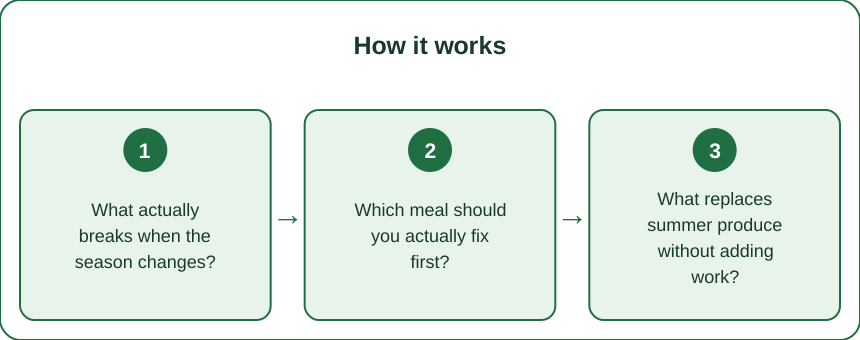
How do you make it survive the next three months?
Set it up for the season you’re actually in, not the one you wish you had.
Cook once, eat twice. Doubling a tray of roasted vegetables costs zero extra minutes and buys you Wednesday. This is the highest-return habit in autumn cooking and it works precisely because oven cooking scales for free.
Shop once with a list of building blocks, not meals. A protein, two roastable vegetables, a green, a can of beans, frozen berries, olive oil, one bag of nuts. From that you can build most of a week without ever planning a specific dinner.
Put one recurring anchor in the calendar. A Sunday roast tray, a Wednesday soup. One fixed point stabilizes everything around it.
Decide your two fallbacks in advance. Everyone has nights where cooking doesn’t happen. Choose the two takeout or shortcut options that are least bad and make them the default, so the tired decision has already been made.
And give it until mid-October before judging. The first three weeks of a schedule change are chaos for everyone; what your eating looks like in week six is the real signal. This is general information, not medical advice — if you’re managing a diagnosed inflammatory condition, work with a clinician or dietitian on specifics.
TL;DR:
- September breaks the structure, not the intention: the cooking window moves, easy produce disappears, the schedule stiffens.
- Fix one meal — usually dinner — with a rule, not a recipe. One protein, one cooked vegetable, one thing with color.
- Roasting replaces slicing as autumn’s no-technique method. Frozen berries and canned fish are not compromises.
- The pattern over months is what matters. A mediocre meal eaten beats an ideal one skipped.
- Cook once eat twice, shop building blocks, and pick your two fallbacks before you need them.
You don’t need a new diet in September. You need a dinner you can make in the dark when you’re tired.
Keep Reading
This article is for general informational purposes only and is not medical advice. Always consult a qualified health professional for guidance specific to you.