Why an Anti-Inflammatory Diet Feels Like It Stops Working After a Month
Quick Answer: The first month of an anti-inflammatory diet usually removes the largest and easiest contributors - excess alcohol, ultra-processed food, and very low vegetable intake - and the improvement is real. The plateau arrives because the remaining drivers are not dietary at all. Sleep, chronic stress, sedentary time, visceral fat, and untreated conditions account for a large share of chronic low-grade inflammation, and no amount of turmeric compensates for five hours of sleep.
Month one felt like something changed. Month two felt like nothing. You did not do anything wrong - you ran out of the cheap fixes.

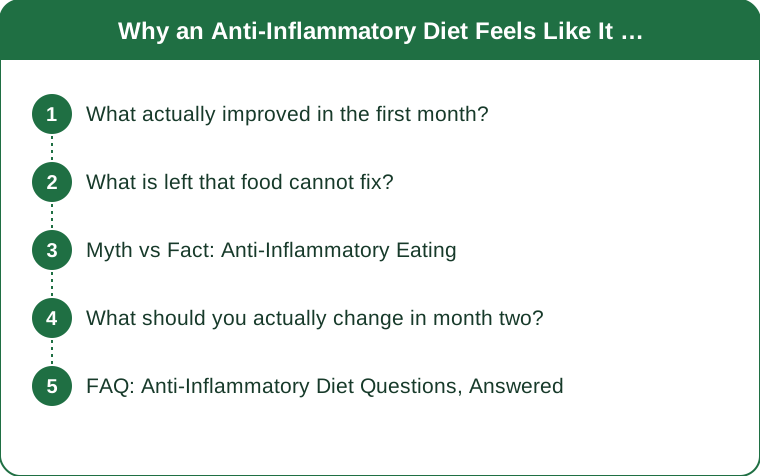
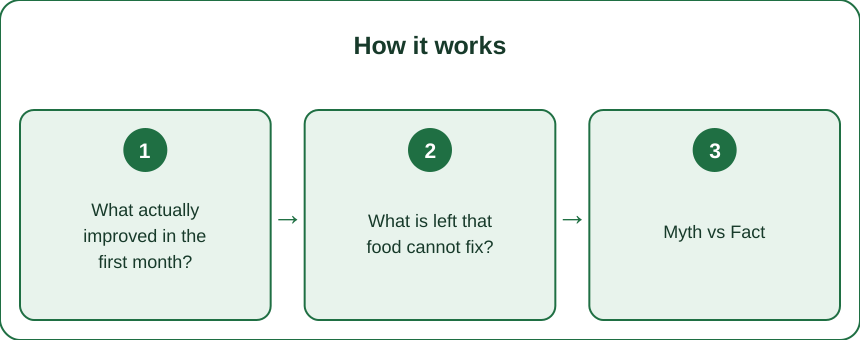
What actually improved in the first month?
You almost certainly removed a large alcohol or ultra-processed food load. Both are strongly associated with markers of systemic inflammation, and reducing them produces a measurable effect relatively quickly. If your baseline included either, most of month one’s improvement came from subtraction rather than from anything you added.
Fiber intake probably rose sharply. Moving from a typical intake of around 15 grams a day to 30 or more changes the gut microbiome composition within days to weeks, and short-chain fatty acid production from fiber fermentation has direct anti-inflammatory effects in the gut lining.
Omega-3 to omega-6 ratio likely shifted. Cutting back on refined seed oils and adding fatty fish changes the substrate available for inflammatory and resolving signaling molecules. This is a real mechanism, though the effect size in practice is more modest than supplement marketing suggests.
And you probably lost some weight without trying. Whole-food diets are less energy dense, and even modest fat loss - particularly visceral fat - reduces inflammatory signaling, because visceral adipose tissue is metabolically active and secretes inflammatory cytokines directly.
Which means the plateau is not a failure of the diet. It is what happens when the largest contributor has been addressed and the next-largest one is somewhere else entirely.
What is left that food cannot fix?
Sleep is almost always the biggest remaining lever. Sleep restriction raises inflammatory markers measurably, and the effect appears within days. Someone eating a near-perfect diet on six hours of sleep is fighting their own nervous system, and no food choice compensates for it. If you are sleeping under seven hours, this is the highest-return change available and it is not close.
Chronic psychological stress does the same thing through a different route. Sustained stress alters cortisol patterns and is associated with elevated inflammatory markers. Month two of a strict diet is also, for many people, a month of added dietary stress - which is an underappreciated way that being extremely rigid about food can work against the goal.
Sedentary time matters independently of exercise. Regular movement has anti-inflammatory effects, and prolonged uninterrupted sitting is associated with worse metabolic markers even in people who exercise. Breaking up sitting every 30 to 60 minutes is a separate intervention from a workout.
Visceral fat is a source, not just a symptom. It secretes inflammatory signaling molecules continuously. Waist circumference is a better guide here than body weight, and reductions in it track with improvements in inflammatory markers better than scale weight does.
And some inflammation is a medical finding, not a lifestyle one. Autoimmune conditions, periodontal disease, untreated sleep apnea, chronic infections, and some medications all raise inflammatory markers and none of them respond to diet. Persistent symptoms deserve a workup rather than a stricter meal plan.

Myth vs Fact: Anti-Inflammatory Eating
Myth: Specific superfoods reduce inflammation on their own. Fact: Overall dietary pattern predicts inflammatory markers far better than any single food. Adding blueberries to an otherwise poor diet does very little; the Mediterranean-style pattern as a whole has the strongest evidence.
Myth: Turmeric supplements deliver what turmeric research shows. Fact: Curcumin has poor bioavailability on its own, and study doses are frequently far higher than culinary amounts and use enhanced formulations. Turmeric in food is fine and unlikely to replicate trial results.
Myth: Nightshades cause inflammation. Fact: There is no good evidence that tomatoes, peppers, eggplant, or potatoes increase inflammation in people without a specific sensitivity. Eliminating them removes nutrient-dense foods for most people with no benefit.
Myth: Gluten and dairy are inflammatory for everyone. Fact: They are for people with celiac disease, wheat allergy, or genuine intolerance. For everyone else the evidence does not support routine elimination, and unnecessary restriction narrows the diet in ways that can reduce fiber and nutrient variety.
Myth: If you are not seeing results, you need to be stricter. Fact: This is the trap the plateau creates. When diet is no longer the limiting factor, tightening it further produces stress and social cost without benefit, and stress itself raises inflammation.
Myth: You can tell your inflammation level by how you feel. Fact: Chronic low-grade inflammation is often asymptomatic. If you want to know, hs-CRP is an inexpensive blood test - though it should be interpreted by a clinician alongside everything else, since it rises with recent infection, injury, and hard exercise.
What should you actually change in month two?
Audit sleep before touching the diet. Track duration for a week honestly. If it is under seven hours, fix that and change nothing else for a month. The improvement will likely exceed anything further dietary tightening would have produced.
Add movement snacks rather than more training. Five minutes of walking every hour of desk work addresses sedentary time, which is a separate variable from your workouts. This is one of the few changes that is both easy and genuinely under-used.
Loosen the diet rather than tightening it. Aim for consistently good rather than occasionally perfect. A pattern you can sustain for two years beats one you abandon in month three, and the evidence is about patterns over years.
Check the omega-3 side specifically. Two servings of fatty fish a week is the common recommendation and most people do not hit it. If you do not eat fish, this is a reasonable place to consider a supplement - and one of the few where the evidence supports it.
Measure waist circumference monthly. It tracks visceral fat better than body weight and it moves on a timescale where you can actually see progress.
And get bloodwork if you have not. An hs-CRP test gives you an actual number instead of a guess, and it turns month three from a matter of faith into a matter of data. Discuss it with your doctor, particularly if you have persistent joint pain, fatigue, or digestive symptoms.
This is general information, not medical advice. Persistent symptoms warrant medical assessment rather than dietary escalation.
FAQ: Anti-Inflammatory Diet Questions, Answered
How long does an anti-inflammatory diet take to work?
Many people notice changes in energy and digestion within two to four weeks, largely from removing alcohol and ultra-processed foods and increasing fiber. Measurable changes in markers like hs-CRP generally take longer, and the plateau after month one usually means non-dietary factors are now limiting.
Why did my anti-inflammatory diet stop working?
The first month typically fixes the largest and easiest dietary contributors. What remains - insufficient sleep, chronic stress, sedentary time, visceral fat, or an untreated medical condition - does not respond to food, so tightening the diet further produces little.
Are nightshades inflammatory?
Not for most people. There is no good evidence that tomatoes, peppers, eggplant, or potatoes raise inflammation in the absence of a specific sensitivity, and eliminating them removes nutrient-dense foods for no clear benefit.
Should I take turmeric supplements for inflammation?
The research generally uses doses and enhanced formulations far beyond culinary turmeric, since curcumin absorbs poorly on its own. Overall dietary pattern, sleep, and movement have stronger evidence, and supplements can interact with medications - check with a clinician first.
TL;DR:
- Month one’s improvement was mostly subtraction - less alcohol, less ultra-processed food, much more fiber - and it was real.
- The plateau arrives because the remaining drivers are sleep, stress, sedentary time, and visceral fat, none of which respond to food.
- If you sleep under seven hours, fix that before changing anything else about your diet.
- Loosening to a sustainable pattern beats tightening; rigid restriction adds stress, which raises inflammation.
- Track waist circumference monthly and consider an hs-CRP test so month three runs on data rather than faith.
Persistent joint pain, fatigue, or digestive symptoms deserve a medical workup, not a stricter meal plan.
Keep Reading
This article is for general informational purposes only and is not medical advice. Always consult a qualified health professional for guidance specific to you.