Four Anti-Inflammatory Breakfast Swaps That Survive a Real Morning
Quick Answer: The highest-value anti-inflammatory breakfast changes are adding protein to a carbohydrate-only morning, swapping refined grains for whole ones with intact fibre, adding a source of omega-3 fats such as walnuts or ground flax, and adding colour in the form of berries or other polyphenol-rich produce. Each takes under two minutes and none requires cooking.
Breakfast is the meal most likely to be a pile of refined carbohydrate eaten in a hurry, which makes it the meal where a small change produces the biggest proportional difference.

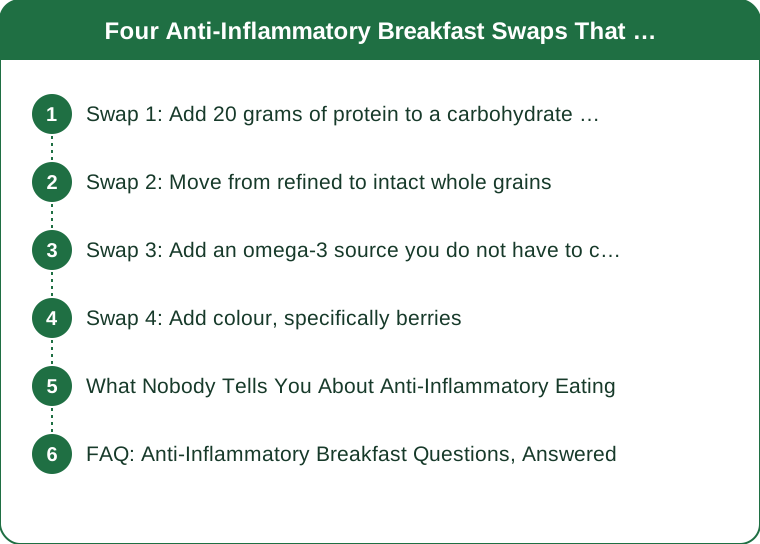
Swap 1: Add 20 grams of protein to a carbohydrate breakfast
Not because protein is anti-inflammatory in itself, but because of what it displaces and what it does to the rest of your morning.
The typical problem breakfast - toast and jam, a pastry, cereal with milk, a fruit juice - is almost entirely refined carbohydrate. It produces a rapid rise and fall in blood glucose, which for many people means hunger by 10:30 and a second refined-carbohydrate snack. Repeated daily, that pattern is associated with poorer metabolic markers, and chronic metabolic stress and inflammation are closely linked.
The two-minute versions:
- Greek yoghurt, 200g, roughly 20g protein - the single easiest swap
- Two or three eggs, boiled in batch on Sunday and eaten cold, roughly 12 to 18g
- Cottage cheese on toast instead of jam, roughly 14g per 100g
- A scoop of whey or plant protein into whatever you already drink
Keep the carbohydrate. This is a swap in composition, not a removal - wholegrain toast with cottage cheese is a better breakfast than either alone.
What to expect: most people notice steadier appetite through the morning within a few days. That is the practical benefit, and it is what makes the change stick long enough for the compositional benefits to matter.
Swap 2: Move from refined to intact whole grains
The distinction that matters is not whole grain on the label - it is how processed the grain is.
A wholemeal bread made from finely milled flour behaves in the body far more like white bread than like a bowl of oats. The fibre is present, but the structure that slows digestion has been destroyed by milling.
Ranked roughly by how intact the grain is:
- Most intact: steel-cut oats, whole rye grains, buckwheat groats, quinoa
- Middle: rolled oats, genuine sourdough rye, coarse stoneground breads with visible grain
- Least intact: wholemeal sliced bread, most breakfast cereals, instant oats
The practical morning versions:
- Overnight oats - rolled oats, milk or yoghurt, made the night before, zero morning effort
- A dense seeded rye bread instead of standard wholemeal toast
- Batch-cooked steel-cut oats for the week, reheated with a splash of milk
Why it matters for inflammation: intact grains deliver fermentable fibre to the gut, where it supports short-chain fatty acid production - one of the better-supported dietary mechanisms linking food to inflammatory markers. Finely milled flour delivers much less of that benefit.
Swap 3: Add an omega-3 source you do not have to cook
The omega-3 story is one of the more consistent areas of anti-inflammatory nutrition, and breakfast is an easy place to act on it.
Plant sources, all no-cook:
- Ground flaxseed, 1 to 2 tablespoons - must be ground, since whole seeds pass through largely undigested. Keep it in the fridge, as it oxidises.
- Walnuts, a small handful, roughly 30g
- Chia seeds, 1 tablespoon, ideally soaked
- Hemp seeds, 2 tablespoons
The caveat worth knowing: plant omega-3 is ALA, which the body converts to the longer-chain EPA and DHA at a low and variable rate, often cited as under 10 percent. Plant sources are genuinely worth including, and they are not equivalent to oily fish.
If you want the direct version at breakfast: smoked mackerel or sardines on rye is a legitimate breakfast in many countries and takes about ninety seconds. Tinned sardines are inexpensive and among the better omega-3 sources available.
A realistic approach: ground flax or walnuts daily at breakfast, plus oily fish twice a week at other meals. That combination is far more achievable than trying to make every breakfast a fish breakfast.

Swap 4: Add colour, specifically berries
The colour compounds in produce - polyphenols and anthocyanins - are the part most consistently associated with lower inflammatory markers in dietary research.
Why berries specifically at breakfast: they need no preparation, they work frozen, and they are among the most polyphenol-dense foods per portion. Frozen berries are nutritionally comparable to fresh and often cheaper, which removes the main practical barrier.
A useful portion: around 80 to 150g, which is a generous handful. Blueberries, blackberries, raspberries, and cherries all qualify; darker is generally better.
Other colour options that need no cooking:
- Cherry tomatoes alongside eggs
- Red cabbage or beetroot, if your breakfast is savoury
- A small handful of pomegranate seeds
- Cinnamon, which has its own polyphenol content and costs nothing to add
One useful reframe: aim for colour variety across the week rather than the same berry every day. Different pigments correspond to different compound families, and variety is the more consistent finding in the research.
Skip the juice version. Fruit juice removes the fibre and concentrates the sugar, which undoes the blood-glucose benefit the rest of the breakfast is trying to achieve.
What Nobody Tells You About Anti-Inflammatory Eating
The single-food framing is mostly marketing. No individual food meaningfully changes inflammatory status. What the research consistently supports is an overall dietary pattern - high in vegetables, fruit, whole grains, legumes, nuts, olive oil, and fish; low in refined carbohydrate, processed meat, and ultra-processed food. Turmeric on top of that pattern is a marginal addition. Turmeric on top of a poor pattern changes very little.
Consistency beats intensity by a wide margin. An adequate anti-inflammatory breakfast eaten every day for a year does far more than an elaborate one eaten for three weeks in January.
Sleep and inflammation are tightly linked. Poor sleep raises inflammatory markers measurably. If you are choosing between an extra twenty minutes making an elaborate breakfast and an extra twenty minutes asleep, the sleep is very likely the better choice.
Coffee is on the good side of the ledger. It is a significant polyphenol source in most Western diets and is broadly associated with favourable outcomes at moderate intake. What you add to it matters more than the coffee itself.
Anti-inflammatory does not mean low calorie. Nuts, olive oil, and full-fat yoghurt are all energy-dense and all part of the pattern. Substituting them in without adjusting elsewhere changes your total intake, which may or may not be what you want.
If you have a diagnosed inflammatory condition, diet is one supporting factor alongside medical management, not a replacement for it. This is general information, not medical advice - discuss dietary changes with your care team, particularly if you take medication.
FAQ: Anti-Inflammatory Breakfast Questions, Answered
How quickly would I notice a difference?
Subjective changes like steadier energy and appetite often appear within a week or two, mostly from the protein and fibre. Measurable changes in inflammatory markers take considerably longer and depend on the whole diet rather than one meal.
Is oatmeal genuinely good or is that a myth?
Genuinely good, particularly steel-cut or rolled rather than instant. Oats provide beta-glucan fibre with reasonable evidence behind it. Instant flavoured sachets are a different product with added sugar and much less intact structure.
Should I take a turmeric or omega-3 supplement instead?
Supplements have a place, especially omega-3 for people who eat no fish, but they work best on top of a decent dietary pattern rather than instead of one. Check with a pharmacist if you take medication, as omega-3 and some other supplements interact with blood thinners.
Is skipping breakfast bad for inflammation?
The evidence is mixed and individual. Some people do well with a later first meal. What matters more is the composition of the meals you do eat and total dietary quality rather than the timing itself.
What is the single best swap if I only make one?
Adding 20g of protein to a carbohydrate-only breakfast. It changes the whole morning’s eating pattern, which has knock-on effects that a single ingredient addition does not.
TL;DR:
- Add roughly 20g of protein to a carbohydrate-only breakfast - the swap with the biggest knock-on effect
- Choose intact grains over finely milled wholemeal; overnight oats are the zero-effort version
- Add ground flax or walnuts daily, and get oily fish twice a week elsewhere
- Add colour, especially berries - frozen works and costs less
- The dietary pattern matters far more than any individual superfood, and sleep matters more than most people account for
Breakfast is the easiest meal to change because it is usually the most repetitive one. Fix the composition once, and the change happens 365 times a year without any further decisions. This is general information, not medical advice.
Keep Reading
This article is for general informational purposes only and is not medical advice. Always consult a qualified health professional for guidance specific to you.