Which Cooking Oil Actually Fits an Anti-Inflammatory Diet? The Answer Isn't What You'd Guess
Quick Answer: Extra virgin olive oil is the most consistently supported oil for an anti-inflammatory diet due to its polyphenol content, but the bigger factor is often how the oil is used — high-heat frying degrades the beneficial compounds in any oil, so cooking method matters as much as the oil itself.
You switched to a ‘healthy’ cooking oil months ago and haven’t thought about it since. But the oil aisle has more nuance than ‘olive oil good, vegetable oil bad,’ and how you use whatever oil you choose changes the picture significantly.

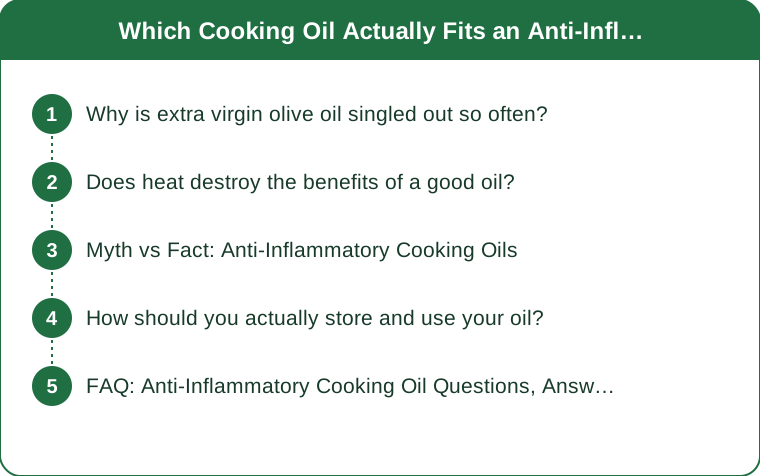
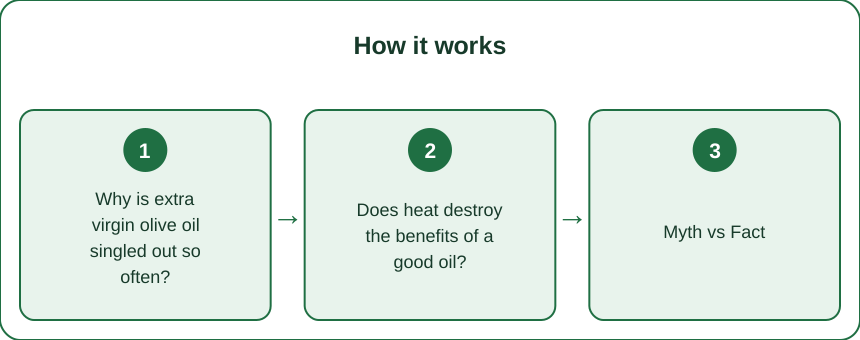
Why is extra virgin olive oil singled out so often?
Extra virgin olive oil contains polyphenols and oleocanthal, compounds studied for anti-inflammatory properties beyond just the type of fat. Refined olive oil and most seed oils lose much of this compound content during processing, even though the fat profile looks similar on a label.
The ‘extra virgin’ and ‘cold-pressed’ labels specifically indicate less processing, which is where those compounds survive.
Does heat destroy the benefits of a good oil?
Yes, partially — high heat above an oil’s smoke point breaks down beneficial compounds and can create oxidized byproducts that work against the anti-inflammatory goal entirely. Extra virgin olive oil has a moderate smoke point (around 375-405°F), fine for sautéing but not ideal for high-heat searing or deep frying.
For high-heat cooking, avocado oil holds up better structurally, though it lacks olive oil’s specific polyphenol profile.

Myth vs Fact: Anti-Inflammatory Cooking Oils
Myth: All seed oils are inflammatory. Fact: The inflammation concern around seed oils relates more to typical dietary ratios (too much omega-6 relative to omega-3) than any oil being inherently ‘toxic’ — moderate use isn’t the same issue as an omega-6-heavy overall diet.
Myth: Coconut oil is anti-inflammatory because it’s natural. Fact: Coconut oil is high in saturated fat and lacks the polyphenol profile that makes olive oil notable — ‘natural’ doesn’t automatically mean anti-inflammatory.
Myth: More expensive olive oil is always better. Fact: Price doesn’t reliably indicate polyphenol content — harvest date and proper storage (dark bottle, cool storage) matter more than price point.
How should you actually store and use your oil?
Keep oil in a dark bottle away from heat and light — sunlight and warmth degrade beneficial compounds over weeks. Buy smaller bottles you’ll use within 2-3 months rather than large bulk bottles that sit half-used for a year.
Use olive oil for finishing, dressings, and moderate-heat cooking; save higher smoke-point oils like avocado for actual high-heat searing.
FAQ: Anti-Inflammatory Cooking Oil Questions, Answered
Is it worth buying a specific ‘anti-inflammatory’ branded oil?
Usually not necessary — a genuine extra virgin olive oil with a recent harvest date does the same job without a marketing premium.
Should I avoid vegetable oil completely?
Occasional use isn’t a major concern; the issue is typically overall dietary balance, not any single use of a standard cooking oil.
Does frying in olive oil cancel out its benefits?
Moderate-heat sautéing preserves most benefits; sustained high-heat frying breaks down more of the polyphenol content, so it’s a reasonable oil for everyday cooking but not ideal for deep frying.
TL;DR:
- Extra virgin olive oil’s polyphenol content is what sets it apart, not just its fat type
- High heat degrades beneficial compounds in any oil — match oil to cooking method
- Seed oils aren’t inherently bad; overall dietary ratio matters more than any single oil
- Store oil in a dark bottle, buy smaller bottles, and use fresh within a few months
The oil matters less than most people think — how and how hot you cook with it matters more. This is general information, not medical advice.
Keep Reading
This article is for general informational purposes only and is not medical advice. Always consult a qualified health professional for guidance specific to you.