How to Eat Anti-Inflammatory at a Restaurant Without Being 'That' Guest
Quick Answer: Order grilled or roasted proteins, ask for sauces and dressings on the side, prioritize vegetables over refined starches, and don’t stress about occasional deviations — an anti-inflammatory pattern is about your overall week, not any single restaurant meal.
Diet advice tends to fall apart the moment real life shows up — specifically, dinner with friends who picked the menu. You don’t need a separate set of rules for restaurants, just a few defaults that keep meals mostly aligned without turning you into the friend who interrogates the server.

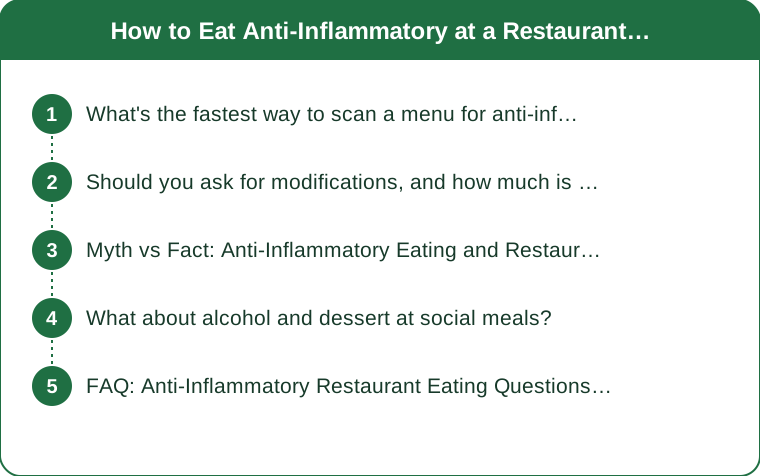
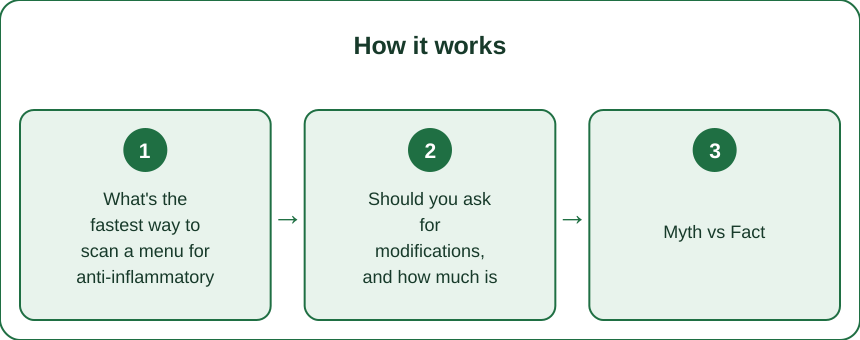
What’s the fastest way to scan a menu for anti-inflammatory options?
Look for grilled, roasted, baked, or steamed preparation words over fried or heavily breaded ones, and scan for dishes built around vegetables and lean proteins rather than pasta- or bread-based mains.
This single scan — cooking method plus base ingredient — gets you most of the way there without needing to analyze every ingredient on the plate.
Should you ask for modifications, and how much is reasonable?
Sauce or dressing on the side is a low-friction, widely accepted request that cuts a meaningful amount of added sugar and refined oil without inconveniencing the kitchen.
Beyond that, one or two simple swaps (extra vegetables instead of fries, for example) is normal restaurant behavior — a full ingredient interrogation usually isn’t necessary and can make shared meals more stressful than they need to be.

Myth vs Fact: Anti-Inflammatory Eating and Restaurants
Myth: One inflammatory restaurant meal undoes a week of good eating. Fact: Inflammation responds to overall dietary patterns over time, not single meals — one dinner out has minimal measurable impact on a generally anti-inflammatory week.
Myth: You have to avoid restaurants entirely on this way of eating. Fact: Most menus have at least 2-3 reasonably aligned options if you know what to scan for — full avoidance isn’t necessary.
Myth: Being ‘that’ guest with a dozen modifications is the only way to stay on track. Fact: One or two simple requests (sauce on the side, swap the starch) usually gets 80% of the benefit with none of the social friction.
What about alcohol and dessert at social meals?
Neither needs to be off-limits entirely — moderate amounts occasionally fit within a pattern-based approach better than strict all-or-nothing rules, which tend to backfire into overeating later.
If inflammation is a specific medical concern (not just general wellness), it’s worth discussing alcohol specifically with a doctor, since individual tolerance varies more than general diet advice accounts for.
FAQ: Anti-Inflammatory Restaurant Eating Questions, Answered
What should I order first if I’m not sure what’s anti-inflammatory on a menu?
A grilled protein with a vegetable side is a safe, widely available default at almost any restaurant type, from casual to upscale.
Is it rude to ask for sauce on the side?
No — it’s one of the most common and accepted modification requests in restaurant service; kitchens handle it routinely.
Does one ‘bad’ meal out actually cause noticeable inflammation?
Not meaningfully on its own — inflammation tracks with overall patterns over weeks, so a single meal has limited measurable individual impact.
TL;DR:
- Scan for grilled/roasted/baked prep words and vegetable-forward mains as a fast filter
- Sauce/dressing on the side is a low-friction request that covers most of the benefit
- One meal doesn’t undo a week — inflammation responds to overall patterns, not single dinners
- Alcohol and dessert don’t need to be off-limits; moderation fits better than strict avoidance
Eating out anti-inflammatory isn’t about perfect control — it’s a few quick defaults that keep most meals reasonably aligned.
Keep Reading
This article is for general informational purposes only and is not medical advice. Always consult a qualified health professional for guidance specific to you.