How to Eat Anti-Inflammatory at a Restaurant Without Being That Person
Quick Answer: The three changes that matter most when eating out are choosing the cooking method over the ingredient list, asking for sauces and dressings on the side, and adding a vegetable side rather than subtracting from the main. Everything else - oil type, exact seasoning, trace ingredients - is a small effect that isn’t worth the social cost of interrogating a server.
An anti-inflammatory pattern that collapses every time you eat with other people isn’t a pattern. Here’s the version that survives a restaurant.

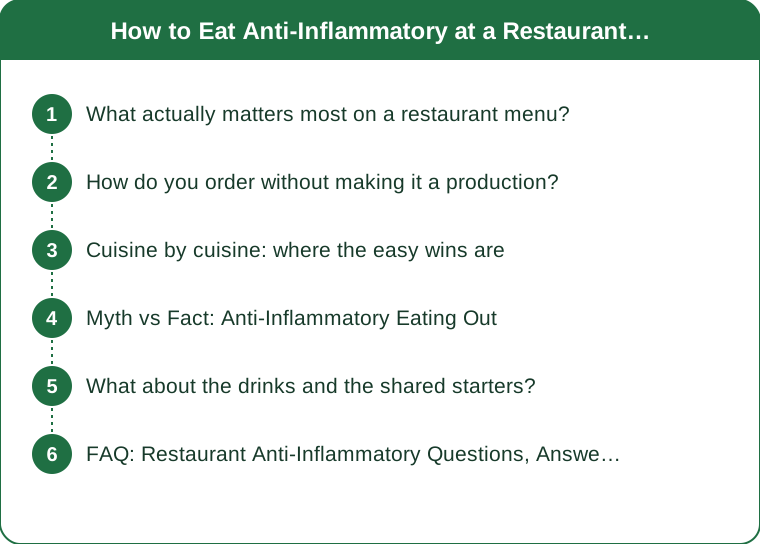
What actually matters most on a restaurant menu?
Cooking method, by a wide margin.
Grilled, roasted, baked, steamed, and braised all sit at the useful end. Deep-fried and heavily battered sit at the other. This one distinction accounts for more of the difference than any ingredient-level decision you could make.
The reason is straightforward: deep frying uses large volumes of repeatedly heated oil, adds substantial energy density, and the batter displaces the food you actually wanted. A grilled version of the same dish is a different meal in nearly every dimension that matters.
Second most important: the sauce. Creamy sauces, sweet glazes, and heavy dressings frequently carry more added sugar and refined oil than the rest of the plate combined. Asking for them on the side is the single most effective request you can make, it’s completely normal to ask, and it lets you use a third of what would have arrived.
Everything past those two is fine-tuning. Which oil the kitchen uses, whether the herbs are fresh, the exact grain in the side - these are real but small, and chasing them is what makes eating out exhausting.
How do you order without making it a production?
Two techniques cover almost every situation.
Add rather than subtract. Asking for a side of greens or extra vegetables is a normal, easy request that no kitchen minds. Asking for a dish rebuilt without four of its components is a different conversation, and it usually produces a worse meal anyway.
Order the dish that’s already close. Every menu has two or three items that need no modification at all - the grilled fish, the roast chicken with vegetables, the bean-based soup, the salad that’s actually substantial. Reading for those takes ten seconds and eliminates the negotiation entirely.
Useful phrasings that land well:
- Dressing on the side, please - universally understood, never a problem
- Could I swap the chips for the salad or vegetables? - most kitchens do this readily
- Is that grilled or fried? - one short question that gets you the most important information
What to skip: asking about cooking oils, requesting no salt, or explaining your dietary reasoning. None of it changes the meal much, and it shifts the table’s attention onto your plate, which is usually the thing you were trying to avoid.
Cuisine by cuisine: where the easy wins are
Some cuisines make this straightforward and some don’t.
Mediterranean and Greek: the easiest by a distance. Grilled fish and meat, olive oil, vegetables, legumes, and herbs are the default rather than the modification. Order almost anything.
Japanese: sashimi, grilled fish, miso, edamame, and vegetable sides are all naturally aligned. Watch the sweet glazes on teriyaki and the tempura section.
Indian: lentil dishes, tandoori items, and vegetable curries are excellent. Cream-based curries and fried breads are where it shifts. Turmeric, ginger, and garlic feature heavily throughout, which is a genuine bonus.
Italian: grilled fish and meat, tomato-based sauces, and vegetable antipasti work well. The pasta itself is not the problem so much as the portion and the cream.
American and pub food: the hardest, because the default cooking method is frying and the default side is chips. Look for the grilled options and the salad that includes real protein.
Fast casual and chains: often easier than expected, since bowl-format restaurants let you build directly. Watch dressings and sweetened sauces.

Myth vs Fact: Anti-Inflammatory Eating Out
Myth: One restaurant meal undoes weeks of good eating. Fact: Dietary patterns are measured over weeks and months. A single meal is statistically irrelevant to a pattern, and treating it as a catastrophe is a reliable route to giving up on the pattern entirely.
Myth: You need to know exactly which oil the kitchen uses. Fact: For most restaurant meals, cooking method and portion size affect the outcome far more than oil type. This is a detail worth caring about at home and not worth interrogating a server about.
Myth: Salad is always the anti-inflammatory choice. Fact: A restaurant salad with a heavy creamy dressing, croutons, and candied nuts can be a poor choice compared to grilled fish with vegetables. The dressing is doing more than the leaves.
Myth: You should eat beforehand so you can order light. Fact: This usually backfires - you eat twice and you’re distracted at the table. Order something you actually want from the aligned options instead.
Myth: Anti-inflammatory eating means avoiding whole categories permanently. Fact: It describes an overall pattern weighted toward vegetables, fish, legumes, whole grains, nuts, and olive oil. It doesn’t require the absence of anything at a single meal. Specific medical conditions may require specific restrictions - that’s a conversation with a doctor or dietitian. This is general information, not medical advice.
What about the drinks and the shared starters?
These are where most of the difference actually happens, and both usually go unexamined.
Drinks often outweigh the food decision. Sweetened soft drinks, cocktails, and large glasses of wine add substantially to the meal without registering as eating. Sparkling water with citrus is the default worth adopting, with whatever else you want on top of it as a deliberate choice rather than an automatic one.
Shared starters are the largest uncontrolled variable at any table. Bread with oil, fried appetisers, and chips arrive before you’ve thought about them and get eaten standing at the edge of a conversation.
The practical approach isn’t refusal - it’s ordering one starter you actually want alongside the fried thing someone else ordered. Olives, a vegetable dish, hummus, a shared salad. Having something you want on the table changes the default from grazing on whatever arrived.
And a note on timing: arriving genuinely hungry is the strongest force acting against every strategy in this article. A small handful of nuts an hour beforehand costs nothing and changes how you read the menu.
FAQ: Restaurant Anti-Inflammatory Questions, Answered
How often can I eat out and still keep the pattern?
If the majority of your meals across a week follow the pattern, restaurant meals fit comfortably. Frequency matters much more than perfection at any single meal.
Should I look up the menu in advance?
It genuinely helps - deciding before you’re hungry and in a social setting is much easier. Two minutes on the way, not an evening of research.
What if I’m eating at someone’s home instead?
Same principle, less control, and the social cost of modification is higher. Eat what you’re served, take more of the vegetables, and let it go.
Is it worth telling the server about dietary preferences?
For allergies and medical requirements, always. For general preferences, on-the-side requests get you most of the benefit without the conversation.
TL;DR:
- Cooking method matters most: grilled, roasted, baked, braised over fried and battered
- Sauces and dressings on the side is the single highest-value request
- Add a vegetable side rather than deconstructing the main
- Mediterranean, Japanese, and Indian menus make this easiest; pub food hardest
- Drinks and shared starters are the biggest unexamined variables
The pattern that works is the one that survives dinner with other people. Perfection at one meal buys you nothing.
Keep Reading
This article is for general informational purposes only and is not medical advice. Always consult a qualified health professional for guidance specific to you.