Is Coffee Inflammatory? The Answer Depends on Three Things You Control
Quick Answer: Plain coffee is not inflammatory for most people - it is a significant source of polyphenols, and observational research broadly associates moderate intake with neutral-to-favorable inflammatory markers. Three variables flip it: what you add (a large sweetened coffee drink can carry more added sugar than a dessert), when you drink it (late caffeine shortens and fragments sleep, and short sleep reliably raises inflammatory markers), and how you personally metabolize it (a meaningful share of people are slow caffeine metabolizers and get a longer, larger physiological response from the same cup). Fix those three and the coffee itself is rarely the problem.
Every anti-inflammatory eating plan on the internet either bans coffee outright or calls it a superfood. The research is less dramatic and considerably more useful.

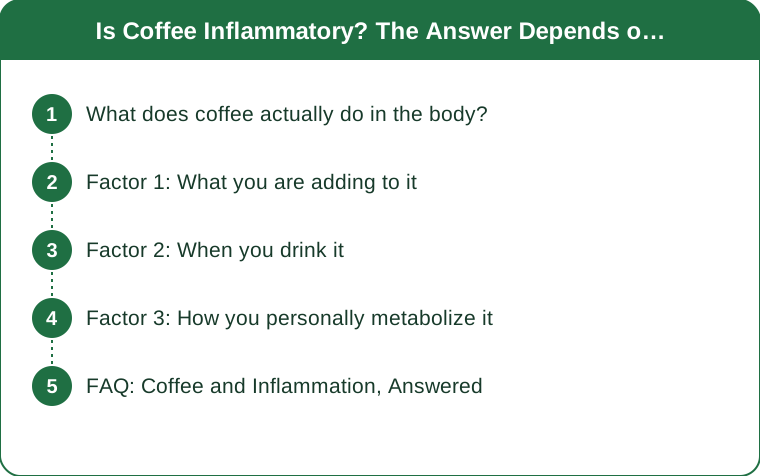
What does coffee actually do in the body?
Coffee is one of the largest sources of polyphenols in a typical Western diet, mostly chlorogenic acids, and polyphenols are the same class of compound that makes berries and olive oil interesting from an anti-inflammatory perspective. For many people, coffee contributes more of them daily than any single food.
Observational research on moderate intake is broadly reassuring. Across large population studies, moderate coffee consumption tends to associate with neutral or slightly favorable markers rather than elevated ones. That is association rather than proof, but the weight of it does not support the idea that coffee drives inflammation.
Caffeine does raise cortisol acutely, particularly in people who do not drink it regularly. Habitual drinkers show a blunted response - the body adapts within days to weeks. A single-dose cortisol bump is not the same thing as chronic elevated inflammation.
The gut effect is real for some people. Coffee stimulates gastric acid and gut motility, and for people with reflux, gastritis, or IBS, that is a genuine and personal reason to reduce or shift timing. Individual digestive intolerance is a valid reason to drink less coffee, and it is a different question from systemic inflammation.
And roast and brew method matter modestly. Unfiltered coffee - French press, Turkish, boiled - contains diterpenes that can raise LDL cholesterol in people who drink a lot of it. Paper filtering removes most of them. If you drink several cups a day of unfiltered coffee and have cholesterol concerns, that is the one preparation detail worth changing.
Factor 1: What you are adding to it
This is where most of the damage happens. A plain black coffee has negligible sugar. A large flavored latte with syrup can carry 40 to 60 grams of added sugar, which is above the daily added-sugar recommendation in a single drink.
Added sugar is the part with the clearest inflammatory story. Repeated large sugar loads drive postprandial glucose and insulin spikes, and habitual high added-sugar intake is consistently associated with elevated inflammatory markers. Consuming that as a drink, without fiber or protein to blunt it, is the least favorable delivery format.
Flavored syrups are the usual culprit, not the milk. Whole milk contributes protein and fat that actually slow absorption. Two pumps of vanilla syrup contribute roughly 10 grams of sugar with nothing else.
Practical downgrades in order: cut the syrup pumps by half, then to zero; go from a large to a medium; add cinnamon or cocoa for flavor that costs nothing; and if you need sweetness, add it yourself so you can see the quantity.
Do not overcorrect into anxiety about the milk. Whether you use dairy, oat, or almond is a rounding error next to whether the drink contains 45 grams of sugar. Fix the big lever first.

Factor 2: When you drink it
Short sleep is one of the most reliable ways to raise inflammatory markers, and late caffeine is one of the most reliable ways to shorten sleep. That is the actual mechanism by which coffee can end up looking inflammatory in someone’s life.
Caffeine has a half-life of roughly 5 to 6 hours in most adults, which means a 3pm cup leaves a meaningful fraction still circulating at bedtime. Research on afternoon caffeine consistently shows reduced total sleep time and reduced deep sleep even in people who insist it does not affect them.
The perception gap is the problem. People who fall asleep fine after evening coffee still show measurably worse sleep architecture. Falling asleep is not the same as sleeping well, and the inflammatory cost tracks the second one.
A practical cutoff is 8 to 10 hours before bed for anyone with sleep complaints, and roughly six hours as a minimum for everyone else. For a 10:30pm bedtime, that is a 12:30 to 2:30pm last cup.
And the first cup can move too. Delaying coffee until 60 to 90 minutes after waking, rather than immediately, tends to reduce the mid-morning crash that drives a second and third cup. Fewer cups, earlier, is the whole optimization.
Factor 3: How you personally metabolize it
Caffeine metabolism varies enormously between people, largely driven by liver enzyme activity. Fast metabolizers clear it quickly and can drink coffee at 4pm without consequence. Slow metabolizers get a longer, higher exposure from the identical cup.
You do not need a genetic test to figure out which you are. The signals are behavioral: if a single afternoon coffee reliably affects your sleep, if two cups make you jittery when others drink four, or if you feel caffeine strongly for five or six hours, you are toward the slow end.
Several things shift your metabolism temporarily. Hormonal contraception slows caffeine clearance substantially. Pregnancy slows it dramatically, which is a large part of why pregnancy guidance caps intake. Smoking speeds it up, which is why people who quit smoking suddenly find their usual coffee intake overwhelming.
Run a two-week test rather than guessing. Week one, keep your normal intake and log sleep quality, resting heart rate on waking, and afternoon energy on a 1-to-10 scale. Week two, move the last cup to before noon and cut total intake by a third. Compare the logs. Two weeks of your own data beats any general recommendation.
And know the general ceiling. Health authorities commonly place around 400 mg of caffeine daily - roughly four 8-ounce brewed coffees - as a reasonable upper limit for most healthy adults, with substantially lower limits during pregnancy. Individual tolerance sits below that number far more often than above it.
This is general information, not medical advice. If you have a heart condition, an anxiety disorder, reflux, or are pregnant, talk to a healthcare professional about your specific caffeine intake.
FAQ: Coffee and Inflammation, Answered
Does coffee cause inflammation?
Plain coffee does not appear to for most people - it is a major dietary polyphenol source and moderate intake associates with neutral to favorable markers in large studies. Added sugar, sleep disruption from late caffeine, and individual sensitivity are what turn coffee into a problem.
Should I cut out coffee on an anti-inflammatory diet?
There is no strong reason to eliminate plain coffee. Cut the syrups and large sweetened drinks, move your last cup earlier, and keep total intake moderate. If you have reflux, gastritis, or IBS symptoms that clearly track with coffee, reducing it is reasonable for that reason.
Is decaf a good option?
Yes. Decaf keeps most of the polyphenol content while removing the sleep and jitter issues, which makes it a genuinely good afternoon substitute rather than a consolation prize. It is not entirely caffeine-free, but the amount is small.
Does adding milk cancel the antioxidants in coffee?
The available research suggests milk has a minimal practical effect on the absorption of coffee polyphenols. Whether you drink it black or with milk is far less important than the sugar content and the time of day.
TL;DR:
- Plain coffee is a leading dietary source of polyphenols and moderate intake is not associated with higher inflammation in large studies.
- The biggest inflammatory lever is what you add - a large syrup-heavy drink can exceed a full day of added sugar in one cup.
- Late caffeine shortens and fragments sleep, and short sleep reliably raises inflammatory markers; aim for a last cup 8 to 10 hours before bed.
- Caffeine metabolism varies widely and is slowed by hormonal contraception and pregnancy - run a two-week self-test rather than following a general rule.
- Around 400 mg daily is a common upper limit for healthy adults, and most people’s personal tolerance sits below it.
Coffee is rarely the villain in an anti-inflammatory diet. The syrup pump, the 4pm cup, and the six hours of sleep that follow it usually are - and all three are yours to change without giving up the coffee.
Keep Reading
This article is for general informational purposes only and is not medical advice. Always consult a qualified health professional for guidance specific to you.